Fan Theories and the Line Between Clue and Guess
Fan theories become easier to discuss when you separate a story’s observable clues from your interpretation, check the source and label what remains a guess.
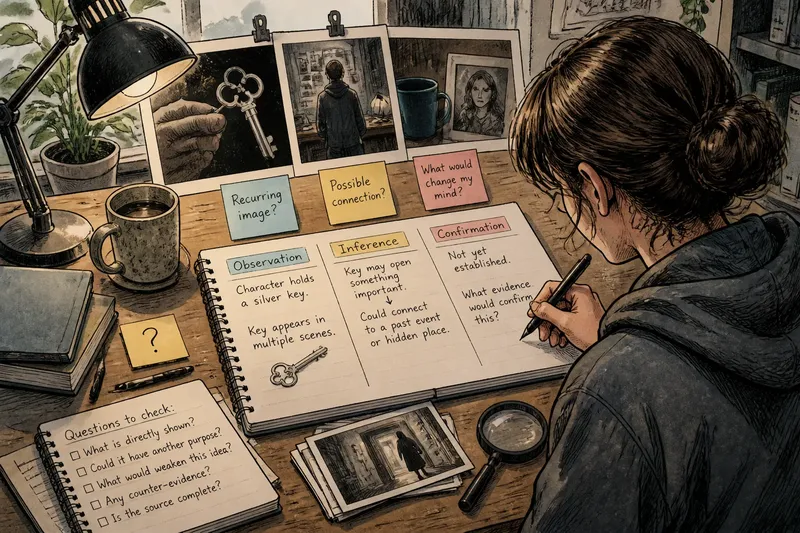
A screenshot of a character holding a silver key can prompt a dozen fan theories, but it only shows the key. To make a fan theory useful to other readers, separate what the story presents from the meaning you assign to it, then make clear what would change your mind.
How can you tell a clue from a fan theory?
A clue is a detail in the story that you can point to: an object, line of dialogue, recurring image or event. A theory connects one or more details to propose an explanation or prediction. The connection may be convincing, but it remains an interpretation until the story or an attributable public source confirms it.
Sort your claims into three layers:
- Observation: what appears or is said in the material.
- Inference: what you think that detail might suggest.
- Confirmation: what the story later establishes, or what a reliable, attributable source explicitly states.
For instance, “the character puts a blue cup beside a photograph” is an observation. “The cup may connect the character to the person in the photograph” is an inference. Calling that connection confirmed requires evidence that establishes it, not simply a plausible reading.
Keep each layer visible as the story develops. A theory can gain support or lose force without the original observation changing.
Which way of reading suits your fan theory?
Is creative speculation right for your idea?
Creative speculation is for imagining what might happen, especially when the story leaves room for several possibilities. Phrases such as “my guess” and “I wonder if” tell readers that you are offering a possibility rather than reporting established story information.
It is fine to build an elaborate theory for fun. Just keep its status attached when you repost or paraphrase it, so repetition does not make a guess sound official.
Does close reading support your interpretation?
Close reading compares details within the work: where an image recurs, how dialogue changes around it, or whether a prop appears in scenes with a shared theme. Explain how those details support your interpretation, and mention anything that cuts against it.
A pattern is a reason to consider an idea, not automatic proof of it. If the same image appears in unrelated scenes, readers need that context to judge how strongly it supports your reading.
When should you leave a theory uncertain?
Use tentative language when a source is incomplete, the wording is ambiguous or the proposed explanation concerns a real person’s private life. You can describe what is publicly available while saying plainly that your interpretation is unconfirmed.
That restraint does not prevent discussion. It helps keep a story interpretation separate from unsupported claims about someone’s personal circumstances.
How should you phrase a fan theory before posting?
Write down the observation and the interpretation separately, then identify where each comes from. A full scene, transcript or official episode description may support what was shown or stated; it does not automatically establish the explanation you attach to it.
- Observation: “The character leaves the letter unopened in this scene.”
- Interpretation: “I read the unopened letter as avoidance.”
- Prediction: “My guess is that the letter will matter later.”
- Confirmation: “A later scene shows the character reading the letter.”
Say you notice the same silver pin in two promotional photographs. First, check both full images and describe the shared detail. Then write, “The pin appears in both; I wonder if the images form a themed pair.” Readers can inspect the images and discuss that possibility without being asked to treat it as a confirmed plot clue.
If you cannot locate the original material, say so. A cropped image or second-hand account can raise a question, but it cannot support the same confidence as a source readers can inspect.
What questions help you judge a theory?
What is directly visible or stated?
Write the observation in neutral terms before explaining what you think it means. If another viewer cannot find that detail in the cited scene or source, revise the claim or identify what remains uncertain.
Could the detail have another purpose?
Consider whether a prop, colour or line might serve a visual, practical or unrelated story purpose. If another explanation fits, present your theory as one possible reading rather than the only answer.
What evidence would weaken your interpretation?
Name any scene or detail that does not fit the theory, and consider what new information would change your mind. If the theory accounts for every possible outcome, it may be too vague to assess.
Does the claim concern a real person?
Keep theories about characters distinct from claims about performers’ health, relationships, identity or private circumstances. If a claim depends on reading an expression or an ambiguous photograph as evidence of private information, do not amplify it as fact.
Why do fan theories lose their context as they spread?
A post that asks “could this be a clue?” can later circulate as “fans confirmed the clue”, especially when screenshots lose their original captions. Repetition makes an interpretation familiar, but it does not provide new confirmation.
Promotional material can encourage questions without acting as a map of hidden story facts. Treat a trailer, poster or interview as a source for what it actually shows or says; do not assign a coded meaning to every striking choice.
When sharing another fan’s idea, credit the interpretation to its source rather than attributing it to the cast, creators or an official account.
What should you check before sharing a fan theory?
- Find the full scene, image, transcript or interview; if the original is available, cite or link it, and if not, describe the source as incomplete.
- Compare your observation with the source; if the detail is visible or stated, describe it neutrally, and if it is not, remove it or mark it uncertain.
- Separate the inference from the observation; if the explanation goes beyond what the source establishes, label it as an interpretation or guess, and if it does not, state what the source confirms.
- Look for another plausible explanation; if one fits the detail, acknowledge it and keep your theory tentative, and if none does, explain why your reading fits without calling it proven.
- Check for counter-evidence in the surrounding scene or other relevant material; if it complicates your idea, include it, and if you find none, say only that you have not found any.
- Check who made the original claim; if it came from a fan, credit it as fan interpretation, and if an attributable official source made it, quote or summarise only what that source actually says.
Imagine you have a clip showing a character turning a silver key, a fan repost claiming it opens a hidden room, and no later scene establishing that explanation. First, locate the full clip and confirm that the key appears; next, note that the hidden room is the fan’s inference, not something shown in the clip. Then check the surrounding scene for another explanation and find that the character uses the key to open a visible cabinet. Your resulting post can say the key may have further significance, but the clip confirms only that it opens the cabinet; the hidden-room idea remains a guess.
For fan theories, keep the source, interpretation and confidence level together when you post or share. That makes room for lively readings while helping readers see which details are established and which remain open to debate.